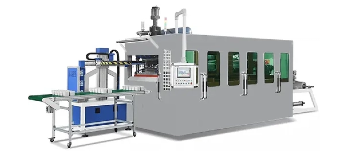
Plastic thermoforming is a popular manufacturing process that allows for the efficient creation of plastic cups, containers, and other packaging products. The key to successful cup thermoforming lies in the precision and coordination of the thermoforming machine, which consists of several essential components. The four most important elements of a cup thermoforming machine are the heating system, forming/mold system, cooling system, and control system. These four core elements work together to ensure that the plastic sheets are molded into high-quality, accurate cups that meet the required specifications. In this article, we will explore the function of each core element, how they contribute to the production process, and why they are critical for maintaining product quality and machine efficiency.
What Is Cup Thermoforming?
Thermoforming is a manufacturing process in which a flat plastic sheet is heated to apliable state, and then formed over or into a mold using vacuum, pressure, or both. The formed sheet is then cooled to retain its new shape, and the excess plastic is trimmed away to produce a finished part. In cup thermoforming, this process is used to create a variety of products, including disposable cups, containers, lids, and other packaging items.
The thermoforming process can be broken down into several stages, including heating, forming, cooling, and trimming. To achieve consistently high-quality parts, the machine needs to perform these steps with precision and accuracy. This is where the four core elements — the heating system, forming/mold system, cooling system, and control system — come into play.
1. Heating System: Preparing the Plastic Sheet
The heating system is the first and most crucial step in the thermoforming process. Before the plastic sheet can be molded into the shape of a cup, it must be heated to a temperature where it becomes soft and pliable. The heating system ensures that the plastic sheet reaches the correct temperature uniformly across its entire surface.
Why Heating Matters
Uniform Heating: Even, consistent heating is critical to ensure the entire sheet is pliable and can be formed correctly. If the heating system fails to heat certain areas of the sheet adequately, those areas may remain too rigid, leading to uneven thickness or incomplete forming.
Material Integrity: Overheating the plastic sheet can degrade the material, causing it to lose its strength or discolor. This is especially important when working with materials like polystyrene (PS), polypropylene (PP), or polyethylene terephthalate (PET), which can degrade under excessive heat.
Efficiency and Cycle Time: Proper heating helps maintain consistent cycle times. If the heating is too slow or uneven, it can prolong the overall cycle, which negatively impacts production efficiency and throughput.
Types of Heating Systems
Infrared Heating: This method uses infrared heaters to heat the plastic sheet. Infrared radiation directly heats the material by emitting radiant heat that is absorbed by the sheet. Infrared heating is often used in thermoforming because it heats the sheet quickly and evenly.
Convection Heating: Convection heaters blow hot air onto the plastic sheet to heat it evenly. This method is less efficient than infrared heating but can still be used for certain applications.
Multiple Heating Zones: High-end thermoforming machines often incorporate multiple heating zones with separate temperature controls. This allows for precise temperature control along the entire length of the sheet, ensuring that the sheet heats uniformly and is ready for molding.
The goal of the heating system is to bring the plastic to its forming temperature while preserving the material’s properties. Without proper heating, the thermoforming process cannot proceed effectively, leading to defects in the final product.
2. Forming / Mold System: Shaping the Cup
Once the plastic sheet has been heated to the proper temperature, it is time to shape it into the final product. This is the role of the forming/mold system. The mold is where the sheet is pressed into the desired shape, and the forming system ensures that the sheet conforms to the mold accurately.
Why the Mold System Matters
Shape and Dimensions: The mold system defines the final shape, size, and dimensional accuracy of the cup. If the mold is poorly designed or worn, it can lead to cups that are deformed, inconsistent in size, or out of tolerance.
Surface Finish: The mold system also controls the surface finish of the cup. If the mold has rough spots or imperfections, those imperfections will be transferred to the surface of the cup.
Material Distribution: The forming process must ensure that the plastic sheet is evenly distributed over the mold. Uneven pressure or vacuum can cause areas of the cup to be thinner than others, resulting in weak spots that may affect the cup’s strength.
Types of Forming Systems
Vacuum Forming: In vacuum forming, the heated plastic sheet is placed over the mold, and a vacuum is applied to suck the sheet tightly against the mold. This method is commonly used for creating shallow cups with simple geometries.
Pressure Forming: This method uses air pressure to push the heated plastic sheet into the mold. It is typically used for deeper or more detailed cups that require greater definition or more complex shapes.
Combination Vacuum and Pressure: Some machines use a combination of both vacuum and pressure to ensure that the sheet forms tightly over the mold while maintaining the correct shape. This hybrid method is particularly effective for producing cups with more intricate shapes or deeper draws.
The quality of the mold itself is just as important as the forming system. Molds must be designed to withstand repeated heating and cooling cycles, and they must be maintained regularly to avoid wear and tear that could affect the quality of the formed cups.
3. Cooling System: Solidifying the Shape
After the plastic sheet is formed into the desired shape, it must be cooled to retain the mold’s geometry. The cooling system is responsible for reducing the temperature of the molded cup quickly and evenly, allowing it to solidify and hold its shape.
Why Cooling Is Crucial
Shape Retention: Proper cooling ensures that the cup retains its shape after being ejected from the mold. If the cooling system is not efficient, the cup may warp or shrink, resulting in defects.
Dimensional Accuracy: Cooling also affects the final dimensions of the cup. Uneven or slow cooling can lead to uneven shrinkage, causing the cup to lose its precise shape or dimensions.
Production Speed: Efficient cooling allows for faster cycle times, enabling the machine to produce more cups in less time. This is particularly important in high volume manufacturing.
Cooling Methods
Water-Cooled Molds: Many thermoforming machines use water-cooled molds with cooling channels built into the mold itself. Water circulates through the channels to remove heat from the mold and the formed plastic, ensuring uniform cooling.
Air Cooling: For less demanding applications, air cooling may be used. Fans or blowers direct cool air onto the molded part to accelerate the cooling process.
The cooling system must be designed to cool the cups uniformly and efficiently. This requires precise temperature control and an even distribution of cooling to ensure that the cups retain their desired shape and size after molding.
4. Control System: Managing the Process
The control system is the brain of the thermoforming machine. It manages and coordinates the various subsystems, including heating, forming, cooling, and ejection. The control system ensures that each step of the thermoforming process is carried out at the right time and under the right conditions.
Why Control Matters
Consistency: A well-calibrated control system ensures that the thermoforming process is consistent across every cycle. This consistency is key to producing cups that meet quality standards.
Quality Control: The control system monitors critical parameters such as temperature, pressure, vacuum levels, and cycle times. By keeping these factors in check, the system ensures that the cups are formed correctly without defects.
Efficiency: The control system optimizes the production process by automating certain tasks, such as sheet feeding, mold clamping, and ejection. This reduces the need for manual intervention and increases production efficiency.
Key Functions of the Control System
Temperature Control: The control system regulates the heating elements to ensure the plastic sheet reaches the correct temperature for forming.
Vacuum and Pressure Control: It manages the vacuum or pressure levels during the forming process to ensure that the sheet conforms to the mold properly.
Cycle Timing: The control system manages the timing of each step in the process, from heating and forming to cooling and ejection, to ensure that the process runs smoothly and efficiently.
A reliable control system is essential for achieving high-quality, consistent results in cup thermoforming. Without it, the process would be more prone to human error and variability, leading to inconsistent cups and increased waste.
Conclusion
The four core elements of a cup thermoforming machine — the heating system, forming/mold system, cooling system, and control system — are all essential for achieving consistent, high-quality cups. Each of these systems plays a crucial role in ensuring that the plastic sheet is heated, formed, cooled, and shaped correctly, and that the final cups meet the desired specifications.
By understanding the function of each element and how they work together, manufacturers can optimize the thermoforming process, improve product quality, and reduce waste. Regular maintenance and calibration of these core elements are crucial to ensuring long-term machine performance, reducing downtime, and maintaining production efficiency.
Whether producing disposable cups, food containers, or other types of molded plastic products, the importance of these four core elements cannot be overstated. Proper care and attention to each system will ensure smooth, efficient production of high-quality cups, every time.


