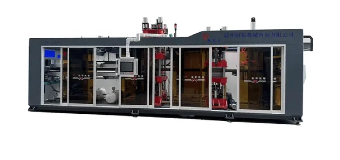
When designing or operating a thermoforming machine, two of the most crucial decisions involve selecting the correct sheet thickness and cooling system. These factors directly influence product quality, production efficiency, and the overall performance of the machine. Understanding how to choose the appropriate sheet thickness and cooling system will help you achieve optimal results, minimize material waste, and improve production speed. This article will walk you through the key considerations when determining sheet thickness and cooling requirements for thermoforming processes.
Understanding the Role of Sheet Thickness in Thermoforming
What Is Sheet Thickness in Thermoforming?
In thermoforming,plastic sheets of various thicknesses are heated until they become pliable, and then formed over or into a mold to create the final part. The sheet thickness plays a significant role in the overall performance of the thermoforming process, as it affects the material flow, part strength, and final dimensions of the product. Choosing the right sheet thickness is crucial for ensuring that the formed part meets the desired specifications.
How Sheet Thickness Affects the Thermoforming Process
Material Stretching and Wall Thickness:
When a plastic sheet is heated and drawn into the mold, it stretches. The more the material stretches, the thinner the wall of the final part becomes. The draw ratio—the relationship between the surface area of the formed part and the original sheet area—helps determine how much the sheet will stretch and how the material will behave. For deep or complex parts, a thicker sheet may be needed to prevent excessive thinning.
Strength and Durability:
Thicker sheets result in stronger, more rigid parts, while thinner sheets are more suitable for lightweight products like packaging. For instance, a thin sheet might be ideal for producing disposable trays or clamshell containers, while thicker sheets are better for creating durable parts like housings or containers that need to withstand physical stress.
Heating Time and Efficiency:
Thicker sheets require longer heating times to reach the desired forming temperature. This can impact the cycle time and energy consumption during production. Conversely, thinner sheets heat up faster, which can increase production speed but may sacrifice strength.
Material Waste:
Using excessively thick sheets for simple or shallow parts results in unnecessary material waste. The optimal sheet thickness should be carefully calculated to avoid overusing material, which directly impacts cost and sustainability.
How to Choose the Right Sheet Thickness
Part Design:
The complexity and geometry of the part will influence the sheet thickness selection. For parts with deep draws or complex features, you will need a thicker sheet to maintain consistent wall thickness and avoid excessive thinning. On the other hand, parts with shallow features or simpler designs can be made with thinner sheets.
Material Properties:
Different materials, such as PET, PP, PVC, and HIPS, have varying degrees of stretchability and formability. The material’s properties, including its shrinkage rate, tensile strength, and thermal behavior, should be considered when selecting the sheet thickness. Materials with higher formability require thinner sheets, while those with lower formability may need thicker sheets to maintain the desired part strength and dimensions.
Production Volume:
For high-volume production, thinner sheets are often preferred because they are more efficient in terms of heating time, and they result in faster cycle times. However, for low-volume production or products that require more durability, thicker sheets might be necessary to meet strength requirements.
End-Use of the Product:
Consider the end-use of the product when determining sheet thickness. For example, if the part is intended for use in food packaging, a thin sheet that is lightweight and cost-effective may be sufficient. However, if the part will be used in industrial or automotive applications, a thicker sheet with greater durability and strength will be necessary.
The Importance of the Cooling System in Thermoforming
Why Is the Cooling System Critical?
Once the plastic sheet has been formed over the mold, it must be cooled to retain its shape and prevent warping or distortion. The cooling system plays a crucial role in stabilizing the plastic part, ensuring that it maintains the desired dimensions and properties before being ejected from the mold. Efficient cooling not only improves part quality but also increases production speed by reducing cycle time.
How the Cooling System Works
The cooling system is designed to remove the heat from the molded plastic and solidify it. The cooling process is typically done by circulating air or water through channels embedded in the mold or using external cooling equipment. Cooling is usually done in two stages:
Initial Cooling: After the part is formed, it needs to cool down enough to hold its shape. During this phase, cooling systems typically use air or water-cooled molds to extract heat from the formed plastic.
Final Cooling: After the initial cooling, the part is further cooled to solidify it completely before removal from the mold. This phase can involve both air and water cooling, depending on the material and part design.
How the Cooling System Affects the Thermoforming Process
Cooling Time:
The cooling time is a critical factor that impacts the overall cycle time of the thermoforming process. Longer cooling times result in longer cycle times, which reduces production speed. However, insufficient cooling can lead to parts that are still too soft or prone to warping, resulting in defects.
Dimensional Stability:
Proper cooling ensures that the plastic part retains its dimensional integrity after being removed from the mold. If cooling is uneven or insufficient, the part may warp, shrink unpredictably, or have inconsistent wall thickness. This can lead to quality issues and the need for rework.
Thermal Stresses:
Cooling must be controlled to avoid thermal stresses that can cause cracking, warping, or deformation of the part. Too rapid or uneven cooling can create areas of high stress within the plastic, resulting in defects.
Choosing the Right Cooling System
Water-Cooled Molds:
Water cooling is one of the most commonly used methods for cooling thermoformed parts, especially for thick-gauge parts or large products. Water-cooled molds have embedded channels through which water flows to absorb heat from the mold. This method provides fast and efficient cooling, ensuring that the part solidifies evenly and quickly. It is ideal for high-volume production and complex parts with thicker walls.
Air-Cooled Molds:
For thinner parts or simpler molds, air cooling can be sufficient. Air cooling involves circulating ambient or forced air around the mold to remove heat from the part. While air cooling is less efficient than water cooling, it can be more economical and is suitable for less complex parts with shallow draws.
Hybrid Cooling Systems:
In some cases, a combination of water and air cooling is used to optimize the cooling process. For example, water cooling may be used in areas with thick sections or complex shapes, while air cooling is used in areas that are more straightforward or less thermally demanding.
Cooling Efficiency:
The cooling system’s efficiency is directly related to the speed of production. The more efficient the cooling system, the faster the part can be ejected and the next cycle can begin. To optimize cooling efficiency, it's essential to ensure that the cooling channels are designed properly, that there is good heat transfer between the mold and the cooling medium, and that the system is well-maintained.
Balancing Sheet Thickness and Cooling System
When selecting the sheet thickness and cooling system for your thermoforming machine, it is important to balance both elements to achieve the desired part quality and production speed. Here are some general guidelines:
For Thin-Gauge Parts: Use thinner sheets and air-cooled molds. This combination reduces heating and cooling time, optimizing production speed.
For Thick-Gauge Parts: Choose thicker sheets and water-cooled molds. Thicker sheets require more time to heat and cool, so water cooling is more effective in ensuring uniform cooling.
For Complex Parts: Use thicker sheets to ensure consistent wall thickness and a robust structure. Water-cooled molds are ideal for managing the thermal demands of complex geometries.
For High-Volume Production: Focus on reducing cooling time and optimizing material usage. Thin sheets and efficient water cooling are optimal for maximizing throughput.
Conclusion
Choosing the right sheet thickness and cooling system for thermoforming is essential for optimizing product quality, production efficiency, and cost-effectiveness. By considering factors such as part geometry, material properties, and production volume, manufacturers can make informed decisions to achieve the best results. A balanced approach to sheet thickness and cooling, tailored to the specific needs of the production process, will help ensure consistent, high-quality thermoformed products.
Wenzhou Yicai Machinery Technology Co., Ltd. specializes in providing advanced thermoforming machines and cooling systems designed to meet the diverse needs of manufacturers. Their expertise and technology can help businesses optimize their production processes, reduce costs, and enhance product quality.


