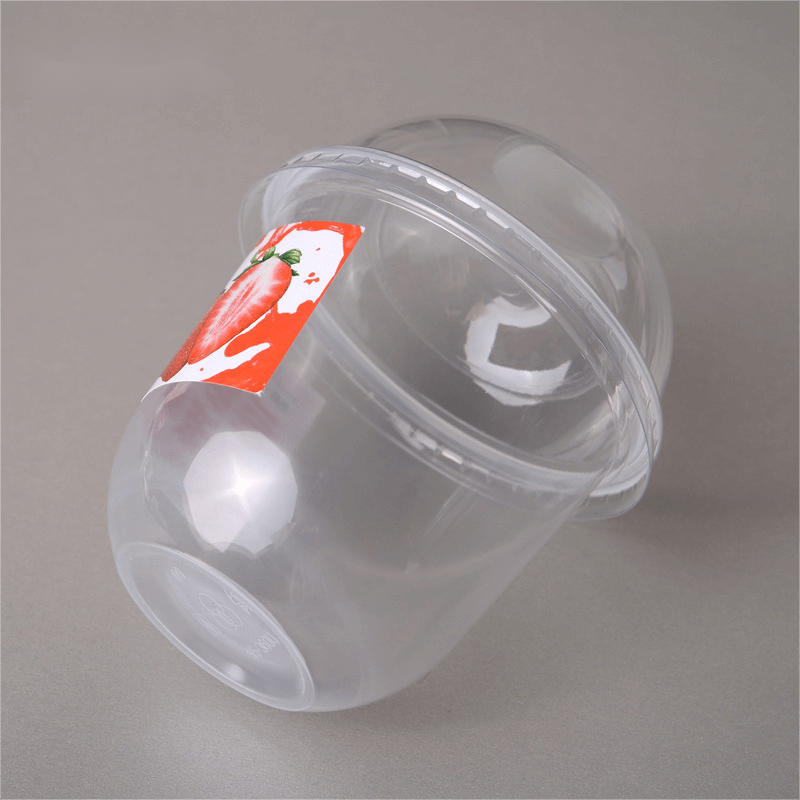
Thermoforming machines have become indispensable in modern packaging, especially within the food packaging industry, where precision, speed, and quality directly impact product safety and consumer satisfaction. Selecting the right thickness and cooling system for a thermoforming machine is a critical decision that influences everything from production efficiency to end-product quality. This article explores the essential factors involved in making these selections, delving into technical insights, product comparisons, and the latest trends in thermoforming technology to empower manufacturers to optimize their operations effectively.
Understanding Thermoforming Machines and Their Core Components
A thermoforming machine shapes heated plastic sheets into custom molds to create packaging such as trays, containers, and lids. Its core components include the heating element, forming mold, and cooling system. The thickness of the plastic sheet and the efficiency of the cooling system are vital parameters directly affecting product durability, accuracy, and cycle time.
Why Thickness Matters in Thermoforming
The thickness of the plastic material used in a thermoforming machine affects structural integrity, cost, and application suitability. For example, food packaging requires precise wall thickness to ensure safety, durability, and functionality such as microwave heating resistance or leak prevention. Variations in thickness can lead to defects like warping, insufficient sealing, or compromised barrier properties.
Role of Cooling Systems in Thermoforming
After the plastic sheet is molded, it must be cooled rapidly to retain its shape and dimensional stability. An efficient cooling system not only shortens cycle time but also reduces defects such as deformation and shrinkage. Cooling methods range from water-cooled molds to air-cooling systems, each with different energy requirements and efficiency levels.
How to Choose the Right Thickness for Your Thermoforming Machine
Selecting the correct thickness depends on several interrelated factors including material type, product application, production speed, and cost considerations. Here we analyze these factors with the latest insights.
1. Material Type and Thickness Range
Different materials have varying optimal thickness ranges for thermoforming. Common food-grade materials used include PP (Polypropylene), PET (Polyethylene Terephthalate), and PS (Polystyrene). The modular thermoforming machine system supports materials within the thickness range of 0.15mm to 2.5mm, covering most food packaging needs.
| Material | Typical Thickness Range (mm) | Key Characteristics |
| PP | 0.15 - 2.0 | Good chemical resistance, microwave safe |
| PET | 0.18 - 2.5 | Excellent clarity, strong barrier properties |
| PS | 0.2 - 1.5 | High rigidity, cost-effective |
2. Product Application and Functional Requirements
The thermoforming machine must match the thickness to the intended use of the product:
Ready-to-eat food trays: Require uniform thickness with tight tolerances to withstand modified atmosphere packaging.
Microwave heating containers: Need thicker, heat-resistant walls to prevent deformation.
Display trays: Often thinner, prioritizing clarity and lightweight design.
The integrated temperature control module with ±1℃ precision in advanced thermoforming machines ensures uniform wall thickness, keeping the coefficient of variation (CV) below 3%, which is crucial for meeting stringent food safety standards.
3. Production Efficiency and Material Waste
Thicker sheets increase cycle time due to longer heating and cooling phases. Conversely, very thin sheets can cause frequent product defects, raising waste and cost. Balancing thickness is essential for optimizing throughput and minimizing raw material waste. For example, the production line mentioned achieves an 18% reduction in raw material waste while maintaining high output.
Selecting the Optimal Cooling System for Thermoforming Machines
An effective cooling system maximizes production speed and product quality. Below is a detailed breakdown of different cooling technologies and how to choose the best fit.
1. Water-Cooled Mold Systems
Water-cooled molds are standard in many thermoforming machines due to their excellent heat transfer capabilities.
Advantages: Rapid cooling reduces cycle time; ensures dimensional stability.
Considerations: Requires complex plumbing and maintenance to prevent corrosion or scaling.
Best Use: High-volume production where speed and consistency are critical.
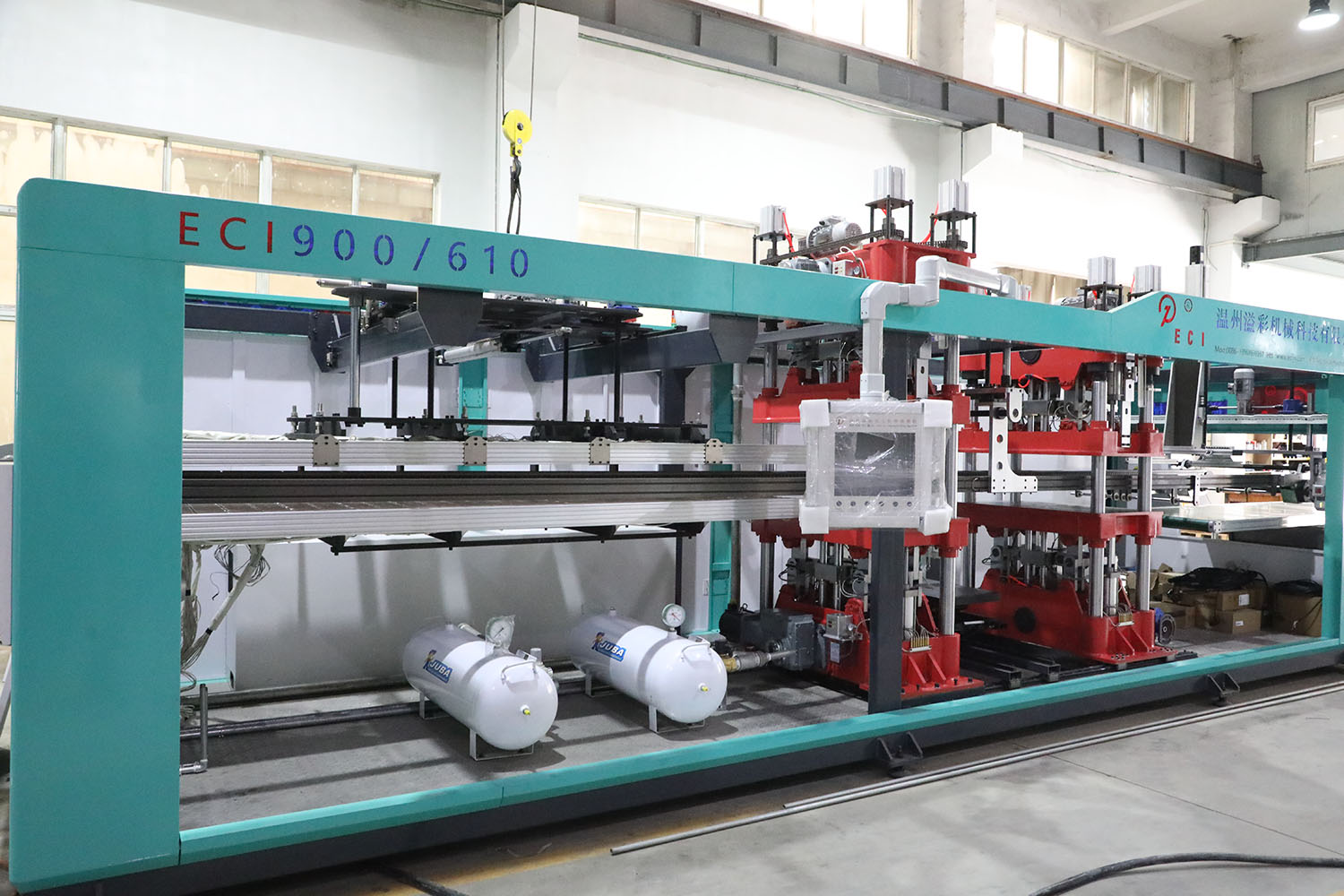
The multi-station thermoforming system with a 3-station rotary mold integrates advanced cooling channels ensuring rapid and uniform heat dissipation.
2. Air Cooling Systems
Air cooling is simpler but less efficient than water cooling.
Advantages: Low maintenance, no risk of leaks.
Considerations: Longer cooling times can limit production speed.
Best Use: Low to medium production volumes, or materials sensitive to moisture.
3. Hybrid Cooling Solutions
Combining water and air cooling systems can optimize performance, reducing energy consumption while maintaining quality. For instance, the servo regenerative braking system incorporated in modern thermoforming machines saves 35% energy compared to traditional cooling methods.
Product Comparison: Thermoforming Machine Thickness and Cooling System Features
| Feature | Multi-station Thermoforming System | Smart Cup Forming Unit | High-Precision Lid Production Line |
| Material Thickness Range | 0.15mm – 2.5mm | Supports 50ml – 1000ml cup capacities | Ultra-thin lids with 0.01mm mold accuracy |
| Cooling System | Advanced water-cooled rotary molds | Dual servo drive with optimized cooling | Ultrasonic sealing edge with cooling |
| Temperature Control | ±1℃ precision regulation | Patented anti-leakage with heat resistance | Oxygen transmission rate < 5cc/m²/day |
| Production Speed | High-speed continuous molding | Ultra-high speed 5000 CPH | Precision sealing for airtight fit |
| Sustainability Features | Energy-saving servo regenerative braking system | Optional nano-antibacterial coating | 30% plant-based PLA composites |
Frequently Asked Questions (FAQs)
Q1: How does material thickness affect the cycle time in a thermoforming machine?
Thicker materials require longer heating and cooling periods, increasing cycle time. Conversely, thinner materials heat and cool faster but may compromise product strength.
Q2: What is the ideal cooling system for high-speed thermoforming lines?
Water-cooled molds are ideal for high-speed lines due to their efficient heat transfer, enabling rapid cooling and shorter cycle times.
Q3: How does temperature control impact thickness uniformity?
Precise temperature control (±1℃) ensures uniform softening of plastic sheets, leading to consistent wall thickness and reducing defects.
Q4: Can thermoforming machines handle biodegradable materials?
Yes, modern machines support biodegradable composites like PLA, requiring careful thickness and cooling adjustments to maintain product quality.
Q5: What are the energy-saving options in thermoforming machines?
Technologies such as servo regenerative braking systems can save up to 35% energy by recovering and reusing energy during operation.
Conclusion
Choosing the right thickness and cooling system for your thermoforming machine is a multifaceted decision requiring a deep understanding of material properties, production goals, and technological capabilities. With the latest innovations—such as intelligent temperature control, energy-efficient cooling, and integration with Industry 4.0 systems—manufacturers can achieve unparalleled product quality, operational efficiency, and sustainability.
Incorporating modular thermoforming production lines with multi-station systems, smart cup forming units, and high-precision lid production lines provides a comprehensive packaging solution from raw materials to finished products. These systems have proven their effectiveness by supporting major global food supply chains, achieving high yields and significant reductions in material waste.
By carefully analyzing your production needs and leveraging cutting-edge thermoforming technology, you can optimize your packaging processes, reduce costs, and meet the evolving demands of the food packaging market with confidence.


